


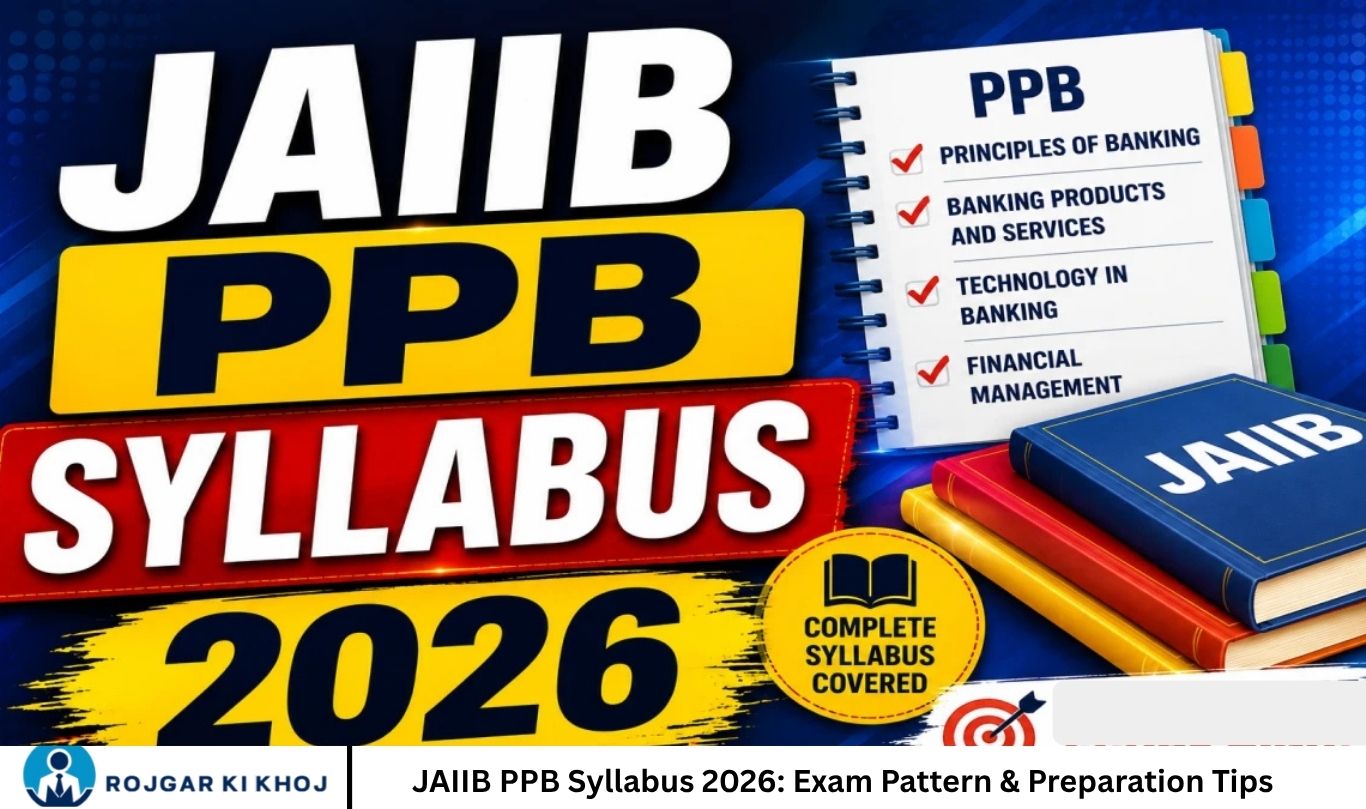
JAIIB PPB Syllabus 2026 is an important resource for candidates preparing for the Principles & Practices of Banking paper under the Junior Associate of the Indian Institute of Bankers examination. The PPB paper focuses on practical banking knowledge, customer relationships, banking operations, lending, digital banking, cybersecurity and professional ethics. Candidates should study the complete syllabus carefully before beginning their preparation because the paper covers a broad range of banking concepts. A structured study plan based on the official syllabus can help candidates complete every important topic and improve their performance in the examination.
JAIIB PPB Exam Pattern 2026
The JAIIB Principles & Practices of Banking exam is conducted in online mode and generally consists of objective-type questions. The paper carries 100 marks and the examination duration is two hours. Candidates are required to demonstrate their understanding of banking concepts, procedures, regulations and practical applications. There is no negative marking for incorrect answers, which allows candidates to attempt questions even when they are uncertain about an answer. However, effective time management remains important because candidates need to solve the complete paper within the prescribed examination duration.
Module A: General Banking Operations
Module A of the JAIIB PPB syllabus focuses on general banking operations and the relationship between banks and their customers. Candidates need to understand the different types of banker-customer relationships and the legal responsibilities associated with them. The module covers deposit products, account opening procedures, different categories of customers, nomination facilities, inoperative accounts and unclaimed deposits. KYC and AML are particularly important areas because candidates need to understand customer identification, customer due diligence, money laundering prevention, terrorist financing, FATCA, CRS and related compliance requirements. The module also deals with cheque clearing, collection, cash management, negotiable instruments, payment systems and the responsibilities of paying and collecting bankers.
Banker-Customer Relationship
The banker-customer relationship is one of the fundamental areas of PPB preparation. Candidates should understand how the relationship between a bank and its customer changes depending on the nature of the transaction. Concepts such as debtor and creditor, principal and agent, trustee and beneficiary, bailor and bailee and lessor and lessee should be studied with practical examples. Special banking relationships involving lien, set-off and appropriation are also important because questions may test both their meaning and practical application.
KYC and Anti-Money Laundering
KYC and AML are highly relevant topics for banking professionals and should receive sufficient preparation time. Candidates should understand the objectives of KYC, customer identification procedures, customer due diligence, enhanced due diligence and ongoing monitoring. The syllabus also covers the Prevention of Money Laundering framework, terrorist financing, reporting requirements, CKYCR, FATCA, CRS and correspondent banking. Candidates should also remain aware of important regulatory changes because banking compliance requirements can be updated from time to time.
Deposit Accounts and Banking Services
The syllabus also covers different types of deposit accounts and their operational procedures. Candidates should understand savings accounts, current accounts, term deposits and related services. Account opening requirements for individuals, firms, companies, trusts and other entities are important from an operational perspective. Nomination, settlement of deceased customers’ accounts, inoperative accounts and unclaimed deposits should also be revised. Candidates should connect these concepts with practical branch-level banking procedures to make revision easier.
Clearing, Cash and Remittance Services
Another important part of Module A deals with clearing and cash operations. Candidates should understand cheque clearing, collection procedures and the Cheque Truncation System. Cash handling, cash custody and branch security are also included in the syllabus. Electronic payment and remittance systems such as NEFT and RTGS should be studied carefully, along with the basic differences between different payment channels. Foreign exchange remittances and NRI banking concepts also form part of the broader banking operations section.
Customer Service and Financial Inclusion
Customer service is another important area in the PPB examination. Candidates should understand customer rights, service standards, grievance redressal mechanisms and the RBI Integrated Ombudsman Scheme. The syllabus also introduces financial inclusion and the role of banks in expanding access to financial services. Candidates should understand the importance of basic banking facilities, digital financial services and government initiatives designed to improve financial inclusion.
Module B: Functions of Banks
Module B of the JAIIB PPB syllabus 2026 focuses primarily on the lending and credit functions of banks. It is an important module because banking professionals are expected to understand how credit facilities are structured, assessed, monitored and recovered. Candidates should begin this section by studying the basic principles of sound lending and then move toward different types of borrowers and credit facilities. Fund-based and non-fund-based facilities, working capital finance and term loans are important areas that require conceptual clarity.
Credit Appraisal and Loan Management
Credit appraisal is a major topic under the functions of banks section. Candidates should understand the process of evaluating a borrower’s financial position, repayment capacity, business requirements and available security before sanctioning credit. Working capital assessment, term-loan assessment and credit monitoring should also be studied carefully. Understanding the complete life cycle of a loan, from appraisal and sanction to documentation, monitoring and recovery, can make preparation more effective.
Security and Documentation
Candidates should also study different types of securities accepted by banks and the methods used to create charges over those securities. The syllabus covers secured and unsecured lending along with securities such as land and buildings, goods, documents of title, insurance policies, shares, debentures, book debts, term deposits, gold and vehicles. Documentation and different modes of charging securities are important because questions can test the distinction between various forms of security and their practical use in banking transactions.
NPA and Recovery Management
Non-Performing Assets or NPAs are among the most important topics in the PPB examination. Candidates should understand income recognition, asset classification, provisioning, gross NPA, net NPA and the treatment of stressed assets. The syllabus also covers different legal and institutional mechanisms used for recovery. Candidates should study the SARFAESI Act, Insolvency and Bankruptcy Code, Recovery of Debts and Bankruptcy Act and other relevant legal provisions. Understanding the purpose and application of these recovery mechanisms is more useful than memorising isolated definitions.
Bank Guarantees and Letters of Credit
Bank guarantees and letters of credit are important non-fund-based banking facilities. Candidates should understand their purpose, parties involved, basic procedures and associated risks. The syllabus also covers contracts of indemnity and guarantee, deferred payment guarantees, bill finance and UCPDC 600 in relation to letters of credit. Practical examples can help candidates understand how these instruments are used in domestic and international banking transactions.
Priority Sector and Agricultural Finance
Priority sector lending is another significant area of Module B. Candidates should understand the broad categories covered under priority sector lending and the role of banks in supporting sectors such as agriculture and MSMEs. Agricultural finance topics include crop loans, Kisan Credit Card and other agricultural lending concepts. Government-sponsored schemes, microfinance, self-help group-bank linkage and financial support for weaker sections should also be studied as part of the broader priority-sector framework.
Retail and MSME Banking
Retail banking includes products such as housing loans, personal loans, consumer loans and credit cards. Candidates should understand the basic characteristics and operational features of these products. MSME banking is also important because small and medium businesses require specialised credit facilities. Candidates should study the role of banks in supporting MSMEs and understand the broad principles of appraisal, financing and monitoring in this segment.
Module C: Banking Technology
Module C focuses on banking technology and digital transformation. Candidates should begin by understanding computerisation in banking, networking, Core Banking Solutions and the basic technological infrastructure used by modern banks. The module also covers data warehousing, data mining and operational aspects of CBS. Candidates should understand concepts such as transaction processing, beginning-of-day and end-of-day procedures, access controls, password management and system security.
Digital Banking and Payment Systems
Digital banking is an increasingly important part of the PPB syllabus. Candidates should understand ATMs, debit and credit cards, internet banking, mobile banking and electronic payment systems. The syllabus also covers electronic funds transfer mechanisms, SWIFT, electronic clearing systems and NPCI-related payment infrastructure. Candidates should focus on understanding how different digital payment systems work and how they differ in terms of functionality and application.
Cybersecurity and Digital Risks
Cybersecurity is another important component of Module C. Candidates should understand information-system security, cyber fraud, electronic transaction risks, disaster recovery and cybersecurity frameworks applicable to banks. Data protection and customer security are particularly important because banks handle large amounts of sensitive financial information. Candidates should also understand the basic responsibilities of banks and customers when unauthorised electronic transactions or cyber-related incidents occur.
FinTech, RegTech and Modern Banking
The syllabus also reflects the changing nature of the banking industry by including modern concepts such as FinTech, RegTech, SupTech, account aggregators, open banking and social media banking. Candidates should understand how technology companies and regulatory technologies are changing banking operations. New digital initiatives and emerging payment technologies should also be followed through reliable banking and regulatory sources.
Module D: Ethics in Banks and Financial Institutions
Module D deals with ethics in banks and financial institutions. This section focuses on values, professional conduct, ethical decision-making and responsible behaviour in banking. Candidates should understand why integrity, honesty, transparency and accountability are important in maintaining customer confidence and the reputation of financial institutions. Ethical behaviour is especially important in banking because employees regularly handle confidential customer information and financial transactions.
Ethical Issues in Banking
The syllabus covers several practical ethical issues that banking professionals may encounter. Candidates should understand conflicts of interest, misuse of official position, insider trading, confidentiality of information, bribery and improper financial practices. Workplace ethics, fair accounting practices and responsible decision-making should also be revised. Candidates should focus on understanding how ethical principles can be applied to practical situations rather than simply memorising definitions.
Leadership, Whistleblowing and Corporate Culture
Ethical leadership and organisational culture are also important areas of Module D. Candidates should understand how senior management and employees contribute to establishing an ethical banking environment. Whistleblowing mechanisms, professional responsibility and ethical decision-making are included in this section. The impact of technology on privacy, data security and intellectual property rights should also be considered while preparing for the examination.
JAIIB PPB Preparation Strategy 2026
Candidates should begin their preparation by thoroughly understanding the official syllabus and dividing the four modules into manageable study sessions. Starting with Module A can provide a strong foundation because it introduces several basic banking concepts. Candidates can then devote significant preparation time to Module B because lending, credit, NPAs and recovery involve several interconnected concepts. Module C should be studied with special attention to digital banking, payment systems and cybersecurity, while Module D can be revised through concise notes and practical examples.
Study the Official Courseware
The official IIBF courseware should form the foundation of preparation. Candidates should read the prescribed material carefully and make short notes while studying. Rather than relying entirely on coaching notes or question banks, candidates should first build conceptual understanding from the official study material and then use additional resources for practice and revision.
Follow Banking and Regulatory Updates
Banking regulations and financial-sector practices can change regularly. Candidates should therefore follow important updates issued by RBI and other relevant authorities. Current developments in digital banking, payment systems, KYC, lending, financial inclusion and banking regulations can be useful during preparation. Keeping a separate section for recent updates can make final revision easier.
Practice MCQs Regularly
Regular MCQ practice is essential for JAIIB PPB preparation. Candidates should solve practice questions after completing each module and carefully review every incorrect answer. Instead of simply counting how many questions were answered correctly, candidates should identify why an answer was wrong and revise the underlying concept. This approach can gradually improve both accuracy and confidence.
Prepare Short Revision Notes
Creating short revision notes is particularly useful for PPB because the syllabus contains numerous banking terms, legal concepts, procedures and technology-related definitions. Candidates can prepare separate notes for KYC and AML, lending, NPA classification, recovery laws, payment systems, cybersecurity and ethics. These notes can then be used for quick revision before mock tests and the final examination.
Attempt Mock Tests
Mock tests help candidates become familiar with the examination environment and improve time management. Candidates should attempt full-length tests after completing the syllabus and analyse their performance carefully. Questions that repeatedly cause difficulty should be marked for additional revision. Mock tests should be treated as a learning tool rather than simply a measure of preparation.
Focus on Conceptual Understanding
The best way to prepare for PPB is to understand banking concepts rather than depending entirely on memorisation. Candidates should try to connect every topic with practical banking situations. For example, while studying KYC, think about how customer identification works at a branch; while studying lending, understand how a bank evaluates a borrower; and while studying digital banking, consider how electronic transactions are processed and protected.
Time Management During the Exam
Candidates have limited time to complete the PPB examination, so time management should be practised during mock tests. Easy questions should be answered first, while difficult questions can be reviewed later. Since there is no negative marking, candidates should avoid leaving questions unanswered when they have sufficient time to attempt them. The final few minutes should be reserved for checking unanswered questions and reviewing marked responses.
JAIIB PPB Passing Criteria 2026
The JAIIB rules generally require candidates to secure the prescribed minimum marks in individual subjects or meet the applicable aggregate criteria. Candidates should carefully check the latest IIBF rules for the exact passing conditions, number of attempts and validity provisions applicable to their examination cycle. Understanding these rules before appearing for the examination can help candidates plan their attempts more effectively.
Final Revision Plan
During the final stage of preparation, candidates should avoid trying to learn the entire syllabus again from the beginning. Instead, revision should focus on short notes, important concepts, practice questions, mock-test mistakes and recent banking updates. Module B topics such as lending, NPAs and recovery should receive focused revision, while KYC, digital banking, cybersecurity and ethics should also be reviewed carefully.
Frequently Asked Questions
What is the JAIIB PPB Syllabus 2026?
The JAIIB PPB Syllabus 2026 covers the major concepts of Principles & Practices of Banking, including general banking operations, banking functions, banking technology, digital banking and ethics in financial institutions.
How many modules are included in the JAIIB PPB syllabus?
The PPB syllabus is divided into four major modules. These are General Banking Operations, Functions of Banks, Banking Technology, and Ethics in Banks and Financial Institutions.
What is the JAIIB PPB exam pattern 2026?
The PPB examination is conducted online and consists of objective-type questions. The paper is generally based on 100 marks with a two-hour duration. Candidates should check the latest IIBF examination guidelines for the exact paper structure applicable to their exam cycle.
Is there negative marking in the JAIIB PPB exam?
There is generally no negative marking for incorrect answers in the JAIIB examination. Candidates can therefore attempt unanswered questions when they are unsure, provided sufficient time remains.
Which topics are important in JAIIB PPB 2026?
Important preparation areas include KYC and AML, banker-customer relationships, deposit accounts, lending principles, credit appraisal, NPAs, recovery procedures, priority sector lending, digital banking, payment systems, cybersecurity and banking ethics.
Conclusion
JAIIB PPB Syllabus 2026 covers a wide range of subjects related to modern banking operations. From banker-customer relationships and KYC to lending, NPAs, digital banking, cybersecurity and professional ethics, the syllabus is designed to develop practical knowledge that banking professionals can use in their careers. Candidates should therefore approach the examination with a structured preparation strategy instead of relying on last-minute study.Reading the official courseware, following important regulatory updates, preparing concise notes, practising MCQs and attempting mock tests can make preparation more effective. A clear understanding of the JAIIB PPB exam pattern and module-wise syllabus 2026 will allow candidates to prioritise their preparation and approach the examination with greater confidence.