


Preparing for the SSC CGL 2026 examination, then understanding the SSC CGL Maths Syllabus and Exam Pattern 2026 is essential for building a strong preparation strategy. Mathematics is one of the most important scoring sections in the SSC CGL exam, and candidates who master it can significantly improve their overall rank. This article provides a complete overview of the syllabus, exam pattern, preparation strategy, and PDF download details in a clear and structured way.
Overview of SSC CGL Exam 2026
| Parameter | Details |
|---|---|
| Exam Name | SSC Combined Graduate Level (CGL) Exam 2026 |
| Conducting Body | Staff Selection Commission (SSC) |
| Post Name | Various Group B & Group C Posts |
| Total Vacancies | Approx. 12,256 Posts |
| Exam Mode | Online (Computer-Based Test – CBT) |
| Exam Type | Objective Type (Multiple Choice Questions) |
| Selection Process | Tier-I + Tier-II + Document Verification |
| Official Website | ssc.gov.in |
SSC CGL Exam Pattern 2026 (Updated)
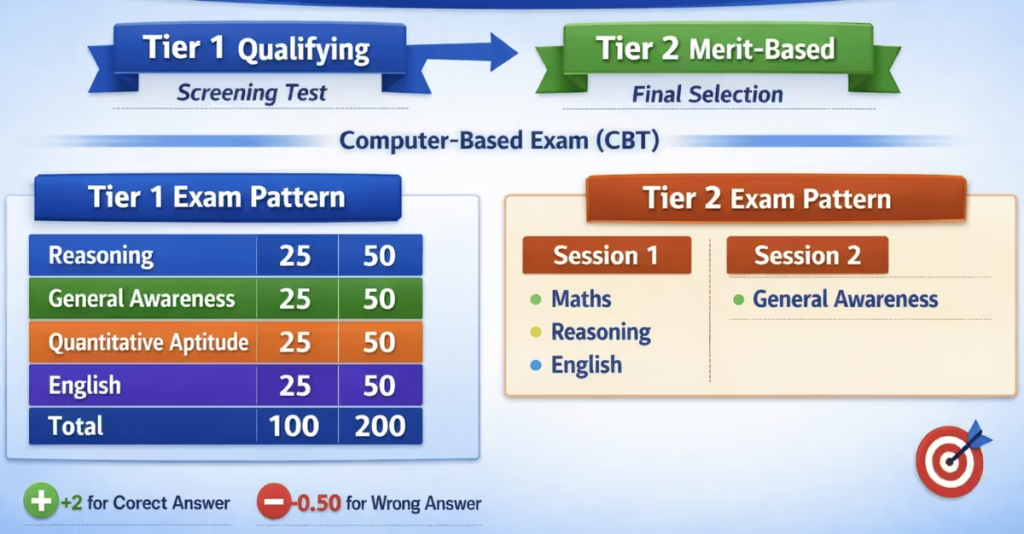
The SSC CGL 2026 exam pattern is designed in a structured manner across multiple tiers. In Tier 1, the exam consists of 100 questions carrying a total of 200 marks, and candidates are given 60 minutes to complete the paper. Each section, including General Intelligence, General Awareness, Quantitative Aptitude, and English Comprehension, carries equal weightage. There is also a negative marking of 0.50 marks for each wrong answer, which makes accuracy very important.
In Tier 2, the exam becomes more advanced and includes compulsory papers, with Mathematics being part of the Quantitative Abilities section. This stage is more conceptual and requires deep understanding of topics. The total marks are higher, and negative marking is 1/3 for each incorrect answer, which further emphasizes precision and speed.
SSC CGL Maths Syllabus 2026 (Detailed Explanation)
The SSC CGL Maths syllabus 2026 is divided into multiple important sections that cover both basic and advanced level concepts. The Number System forms the foundation of mathematics and includes topics like integers, whole numbers, divisibility rules, HCF and LCM, prime numbers, fractions, decimals, and remainder concepts. A strong understanding of this section helps in solving advanced problems easily.Algebra is another important part of the syllabus and includes simplification of expressions, linear equations in one and two variables, quadratic equations, factorization, algebraic identities, and polynomials. This section requires strong conceptual clarity and regular practice to improve speed and accuracy.
Geometry is a high-weightage topic in SSC CGL Maths and includes lines and angles, properties of triangles, congruence and similarity, circles, tangents, quadrilaterals, and basic coordinate geometry. This section often includes diagram-based questions that test conceptual understanding.
Mensuration is one of the most scoring areas in the syllabus and includes calculation of area, perimeter, surface area, and volume of 2D and 3D shapes such as cylinders, cones, spheres, cubes, cuboids, and hemispheres. Memorizing formulas and practicing numerical problems regularly is essential for this section.Trigonometry is an important topic, especially for Tier 2, and includes trigonometric ratios, identities, complementary angles, heights and distances, and practical applications. This section requires practice of formulas and problem-solving techniques.
Statistics and Data Interpretation is another important area that includes calculation of mean, median, mode, interpretation of bar graphs, pie charts, probability basics, and standard deviation at a basic level. This section is considered scoring if practiced regularly with data-based questions.
Profit, Loss, and Discount is a common topic in SSC exams and includes calculation of profit percentage, loss percentage, marked price, selling price, and successive discounts. These questions are generally easy and can be solved quickly with proper understanding of percentage concepts.Time, Speed, and Distance is another frequently asked topic that includes problems related to speed-time-distance formulas, relative speed, trains, boats and streams, and circular motion concepts. This topic is highly important for scoring quick marks in the exam.
Time and Work is also an important part of the syllabus and includes efficiency-based problems, combined work calculations, pipes and cisterns, and wage-related problems. Understanding the relationship between work and time is crucial for solving such questions.Simplification and Approximation is one of the easiest sections in SSC CGL Maths and includes BODMAS rule, square roots, cube roots, fraction simplification, and percentage-based approximations. This section helps candidates save time during the exam.
SSC CGL Maths Topic-Wise Weightage (Expected)
The expected weightage of topics in SSC CGL Maths shows that arithmetic topics such as profit and loss, time and work, and time, speed, and distance carry very high importance. Algebra, geometry, and mensuration also carry significant weightage, especially in Tier 2, while trigonometry and data interpretation are moderately important but still crucial for overall scoring.
SSC CGL Maths Exam Pattern Strategy 2026
To perform well in the SSC CGL Maths section, candidates must follow a balanced strategy for both Tier 1 and Tier 2. In Tier 1, speed and accuracy are the key factors, and candidates should first attempt arithmetic-based questions to secure marks quickly. Time management plays a crucial role, as each second matters in the exam.
In Tier 2, the focus should shift toward conceptual clarity and advanced problem-solving skills. Candidates must practice higher-level questions and regularly solve previous year papers to understand the pattern and difficulty level of questions asked in the exam.
SSC CGL Tier 2 Syllabus 2026 PDF Download
The SSC CGL Tier 2 syllabus PDF is extremely important for candidates preparing for the mains stage of the examination. It provides a clear and structured outline of all the modules and chapters required for Tier 2, helping aspirants focus their preparation in the right direction. The SSC CGL Tier 2 (Mains) syllabus includes key sections such as Mathematical Abilities, Reasoning & General Intelligence, English Language & Comprehension, General Awareness, Computer Knowledge, Statistics, and General Studies related to Finance and Economics. Each of these sections plays a crucial role in the final merit list, making it essential for candidates to study the syllabus carefully.
By referring to the SSC CGL Tier 2 syllabus PDF, candidates can strategically plan their preparation and ensure that no important topic is left out. It also helps in understanding the depth and difficulty level of the exam, allowing aspirants to prioritize high-scoring areas effectively. Since Tier 2 is the deciding stage for final selection, a thorough understanding of the syllabus is essential for success in the SSC CGL 2026 examination.
Best Preparation Tips for SSC CGL Maths 2026
A strong preparation strategy is essential to score well in SSC CGL Maths. Candidates should first focus on strengthening basic concepts before moving to advanced problems. Regular practice is extremely important, and solving at least 30 to 50 questions daily can significantly improve performance.
Short tricks and Vedic mathematics techniques should be learned to improve calculation speed. Previous year question papers must be solved regularly to understand exam trends and question types. Mock tests are also very important as they help improve speed, accuracy, and time management. Additionally, revising formulas regularly is necessary to retain concepts effectively.
Common Mistakes to Avoid
Many candidates lose marks in SSC CGL Maths due to avoidable mistakes such as poor time management, lack of revision, ignoring weak topics, and over-dependence on lengthy methods instead of shortcuts. Not practicing mock tests regularly also affects performance. Avoiding these mistakes can significantly improve exam results.
Why SSC CGL Maths is Important
Mathematics plays a crucial role in SSC CGL as it is one of the highest-scoring sections in the exam. With proper preparation, candidates can easily maximize their marks and improve their overall ranking. The questions are generally pattern-based, which makes regular practice highly effective. A strong command over Maths can significantly increase the chances of clearing the SSC CGL cutoff.
Frequently Asked Questions
What is the SSC CGL Maths syllabus for 2026?
The SSC CGL Maths syllabus for 2026 includes key topics such as Number System, Algebra, Geometry, Mensuration, Trigonometry, Statistics, Data Interpretation, Profit and Loss, Time and Work, and Time, Speed and Distance. These topics cover both basic and advanced-level Quantitative Aptitude required for Tier 1 and Tier 2 exams.
Is the SSC CGL Maths syllabus the same for Tier 1 and Tier 2?
No, the syllabus is similar but not the same. Tier 1 includes basic arithmetic and foundational concepts, while Tier 2 includes advanced-level mathematics with more complex and application-based questions, especially in Algebra, Geometry, and Trigonometry.
Is Maths compulsory in SSC CGL 2026 exam?
Yes, Mathematics is a compulsory section in both Tier 1 and Tier 2 exams. It plays a very important role in scoring high marks and clearing the overall cutoff.
What is the difficulty level of SSC CGL Maths?
The difficulty level is moderate in Tier 1 and moderate to high in Tier 2. Tier 2 Maths requires strong conceptual understanding and regular practice of advanced problems.
How many questions come from Maths in SSC CGL exam?
In Tier 1, 25 questions are asked from Quantitative Aptitude (Maths section), carrying 50 marks. In Tier 2, Maths is included in the Quantitative Abilities module, which has a higher weightage and difficulty level.
Conclusion
SSC CGL Maths Syllabus and Exam Pattern 2026 is designed to test both basic and advanced mathematical skills of candidates. A strong understanding of arithmetic, algebra, geometry, mensuration, and trigonometry is essential for success. With consistent practice, proper revision, and a smart strategy, candidates can easily score high marks in the Mathematics section and achieve their dream government job.